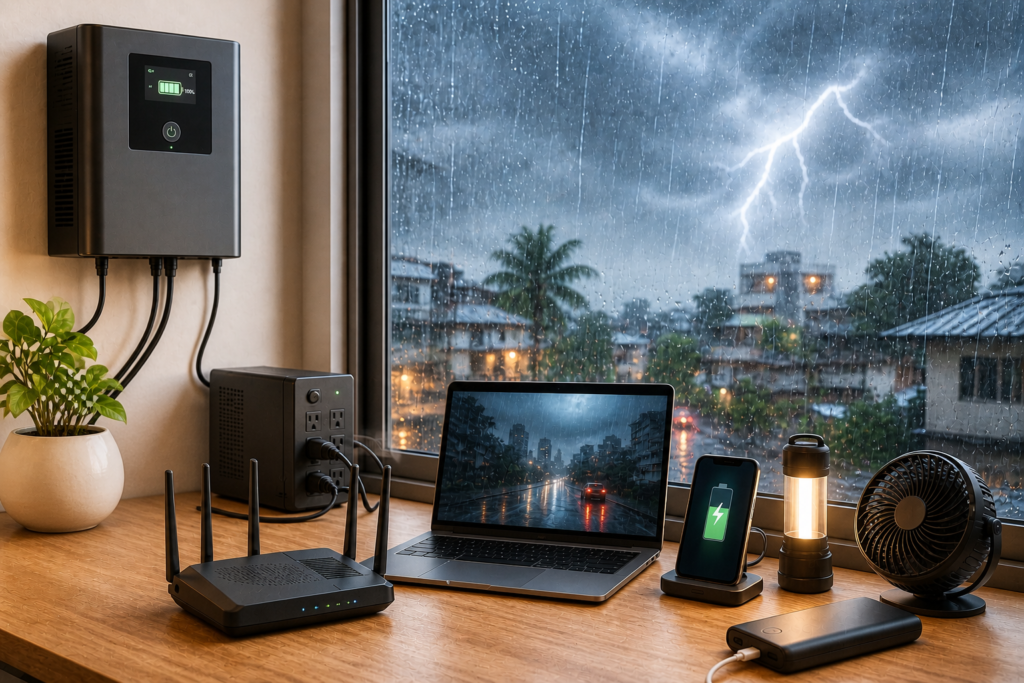
Quick Answer: India’s monsoon season (June–September) brings frequent power cuts, voltage fluctuations, and surges that can damage or destroy electronics. The most effective protection strategy combines a Mini UPS (for routers and small devices), a surge-protected extension board (for computers and appliances), and a full home UPS or inverter (for extended outages). For most households, a Mini UPS with 2–4 hours of router backup costs between ₹1,500 and ₹3,500 and is the single highest-ROI purchase before the rains arrive.
Why Monsoon Is the Most Dangerous Season for Your Electronics ?
Every year, millions of Indian households watch the same scenario play out: the rains arrive, the sky darkens, and within minutes the power flickers — once, twice, then goes out entirely. This is not just inconvenient. It is genuinely dangerous for your electronics.
The monsoon season creates a specific combination of electrical hazards that are distinct from ordinary summer outages. Understanding what’s actually happening to your power supply during these months helps you choose the right protection — and avoid the expensive mistake of doing nothing until something breaks.
The Three Monsoon Electrical Hazards.
Voltage fluctuations are the most common and least visible threat. When large loads suddenly connect or disconnect from the grid during rain (air conditioners switching on, industrial machinery, sudden demand spikes), the voltage delivered to your home swings. India’s nominal supply is 220V, but during monsoon instability, actual delivered voltage can drop to 180V or spike to 260V — both outside the safe operating range of most consumer electronics.
Sudden power cuts are more visible but less dangerous if handled properly. The risk here is not the outage itself but the moment power returns: the surge of electricity that rushes back into the system when grid power is restored can deliver a damaging spike to anything plugged in.
Lightning-induced surges are the most severe but least frequent. A nearby lightning strike can send a voltage spike of thousands of volts through the power lines into your home. A basic surge protector will absorb this and sacrifice itself; an unprotected device simply fries.
What Devices Are Most at Risk?
Not all devices face equal risk. Here’s a priority ranking for protection, based on replacement cost and sensitivity:
| Device | Primary Risk | Recommended Protection |
| Router / Modem | Outage / Surge | Mini UPS |
| PC / Laptop | Surge / Power Loss | Surge Protected UPS |
| Smart TV | Voltage Spike | Surge Protector Switch |
| Refrigerator / AC | Voltage Fluctuation | Voltage Stabalizer |
| Smart Phone | All Three Risk | Certified Chargers |
| Set-Up Box | Surge | Mini UPS |
The Mini UPS: The Most Underrated Monsoon Purchase !
A Mini UPS is a compact battery backup device, typically the size of a small book, designed to power a router, modem, or other low-wattage device for 2–6 hours during a power cut. It costs between ₹1,500 and ₹3,500 and solves the single biggest monsoon complaint in most Indian homes: the internet going down every time the power cuts.
For the growing number of people working from home, a router outage during the monsoon is a professional problem, not just a household inconvenience. A Mini UPS eliminates this entirely.
Beyond work-from-home use, Mini UPS devices are increasingly popular in:
– Small kirana stores and shops where a router outage means no UPI payments can be processed
– Hostel and PG accommodation where a shared router going down affects multiple people
– Home CCTV setups where power cuts create security blind spots
When choosing a Mini UPS for a router, the key specification to check is output wattage. Most home routers draw 5–15W. A Mini UPS rated at 20–45W output is sufficient for a router and a small connected switch. Avoid products that don’t clearly state their output wattage — this is a common omission in low-quality listings.